AEO for Australia + Spain: How to Show Up in AI Answers (ChatGPT, Gemini, Perplexity)
If SEO is the game of ranking, AEO (Answer Engine Optimisation) is the game of getting cited.
In 2026, a growing share of “search” isn’t a list of links. It’s an answer: ChatGPT summarises and cites sources, Google’s AI features generate overviews with links, and Perplexity returns summaries with citations. The winner isn’t always the page sitting #1 — it’s the page the system chooses to quote.
That shift matters even more if you’re targeting Australia + Spain, because multilingual/multi-regional setups are where AEO falls apart in the real world: wrong locale shown to the wrong user, translated-but-not-localised content that feels off, weak local trust signals, and bots blocked without realising you just blocked your future visibility.
This guide gives you a practical playbook to improve your chances of showing up in AI answers across:
-
ChatGPT (Search)
-
Google AI features / AI Overviews + AI Mode
-
Perplexity
No fluff. Just what to do, what to avoid, and how to build a site that’s easy to crawl, understand, trust, and cite.
What AEO actually means in 2026 (and how it’s different from SEO)
SEO: Optimise to rank and earn clicks.
AEO: Optimise to be used as a source inside an AI-generated answer — ideally with a citation and link.
Google’s guidance for AI features says these experiences can surface AI-generated responses with links to explore more on the web. That’s your opportunity: to become one of those sources.
OpenAI’s publisher guidance also makes the direction pretty clear: if you want your content included in summaries/snippets in ChatGPT’s search experience, you need to allow its search crawler access.
So the modern goal isn’t “publish more content”. It’s:
Become the best citable source for the sub-question
AI answers are assembled from smaller building blocks than traditional SERPs:-
definitions
-
step lists
-
comparisons
-
“what to do first”
-
clear explanations with proof
If you package your expertise into quotable blocks, you make yourself easier to cite.
How AI answer engines choose sources (a simple mental model)
Different platforms have different mechanics, but selection tends to boil down to four layers:
1) Access: can the system fetch your page?
If crawlers can’t reach your pages (robots.txt blocks, WAF blocks, auth walls), you’ve basically disqualified yourself.OpenAI documents the crawlers it uses and how webmasters can control them using robots.txt.

2) Understanding: can it parse what you’re actually saying?
Clear headings, explicit definitions, structured lists, and clean page hierarchy help extraction.3) Trust: does your page look credible compared to alternatives?
Google’s stance (and it’s the right stance regardless of platform): content should be helpful, created for people, and reliable enough to stand on its own. Google’s AI-feature guidance reinforces this from a site-owner perspective.4) Usefulness: does it answer this question quickly?
Answer engines favour pages that can be summarised cleanly: direct answer → steps → caveats → sources.Keep those four layers in mind and AEO becomes a system, not a guessing game.
Platform playbooks
AEO for ChatGPT: how to improve your chances of being cited
OpenAI’s documentation is your starting point:-
It uses crawlers with specific user agents.
-
Site owners can manage access via robots.txt.
-
OAI-SearchBot is used for search-related experiences.
1) Make sure you’re not blocking the wrong bot
If you want visibility in ChatGPT search summaries/snippets, review your robots.txt for OAI-SearchBot. OpenAI explicitly documents OAI-SearchBot and GPTBot and notes each setting works independently.A common posture some publishers adopt is:
-
Allow OAI-SearchBot (visibility/citations)
- Disallow GPTBot (training crawler)
Example (illustrative only — tailor to your policy):
User-agent: OAI-SearchBot
Allow: /User-agent: GPTBot
Disallow: /
ChatGPT-style answers tend to cite content that is:
-
specific
-
structured
-
source-backed
Best-performing page patterns:
-
Definition block (40–60 words)
-
Step list (5–9 steps)
-
Decision rules (“If AU only, do X. If AU+ES, do Y.”)
-
Primary sources (Search Central, regulators, standards, vendor docs)
3) Track what you can
OpenAI’s publisher FAQ notes that referral URLs includeutm_source=chatgpt.com, which can help you identify traffic in analytics. AEO for Google AI features: how to be “AI Overview worthy”
Google’s site-owner guidance on AI features is clear: AI Overviews and AI Mode are designed to help users with AI responses and provide links to explore more.So what’s the play?
1) Don’t “optimise for AI”—optimise for clarity + reliability
If your content is vague, generic, or full of unsupported claims, it’s harder (and riskier) to cite. Google’s AI features doc is explicitly about how inclusion works and how to approach content for these experiences.2) Use answer-first structure
To be cite-able, make your content easy to extract:-
Put the answer first
-
Use headings that match questions (“What is…”, “How to…”, “Common mistakes…”)
-
Add proof or examples immediately after the answer
3) Build pages that can stand alone
AI answers compress; your page must still be valuable when someone clicks through:-
step-by-step implementation
-
examples
-
checklists inside the article
-
pitfalls and edge cases
Google’s own PDF explainer on AI Overviews/AI Mode emphasises links for deeper exploration, which means your “depth layer” matters.
AEO for Perplexity: citations, crawl controls, and being realistic
Perplexity’s help centre states:
-
It respects robots.txt directives for its crawler (PerplexityBot) and won’t index full/partial text content if disallowed.
-
However, even if blocked, it may still index the domain, headline, and a brief factual summary.
They also publish bot guidance for webmasters.
Practical AEO moves for Perplexity
-
Allow your public citation pages (guides, explainers, docs) to be crawled
-
Make those pages highly structured with clear sources
-
Keep your best “answer blocks” tight and quote-ready
Important nuance: protect sensitive content properly
There has been public controversy around Perplexity crawling behaviour, including claims from Cloudflare about “stealth” crawling. Whether you treat that as a warning or a debate, the safe operational takeaway is simple:If something must be private, don’t rely on robots.txt alone. Use authentication, WAF rules, and access controls.
For AEO, you want your public pages open — and your private pages actually secured.
The AU + Spain AEO blueprint (where most teams mess it up)
If you’re marketing to Australia + Spain, your biggest risk isn’t “AI”. It’s incorrect international setup + weak localisation, which causes:
-
the wrong language being cited
-
the wrong region ranking
-
duplicate-ish pages that blur authority
-
content that feels “translated” (and loses trust)
1) Get your international structure right (URLs + hreflang)
Google’s guidance on managing multi-regional/multilingual sites is still the best baseline.Common structures:
-
Subfolders:
example.com/au/andexample.com/es/
-
Subdomains:
au.example.comandes.example.com
-
Separate domains (more overhead)
Whichever you choose, implement hreflang so systems understand which version to serve and cite.
Example (illustrative only):
<link rel="alternate" hreflang="en-au" href="https://example.com/au/aeo-guide/" />
<link rel="alternate" hreflang="es-es" href="https://example.com/es/guia-aeo/" />
<link rel="alternate" hreflang="x-default" href="https://example.com/aeo/" />
The AEO benefit is huge: when an AI system looks for a source, you increase your chances it lands on — and cites — the right language version.
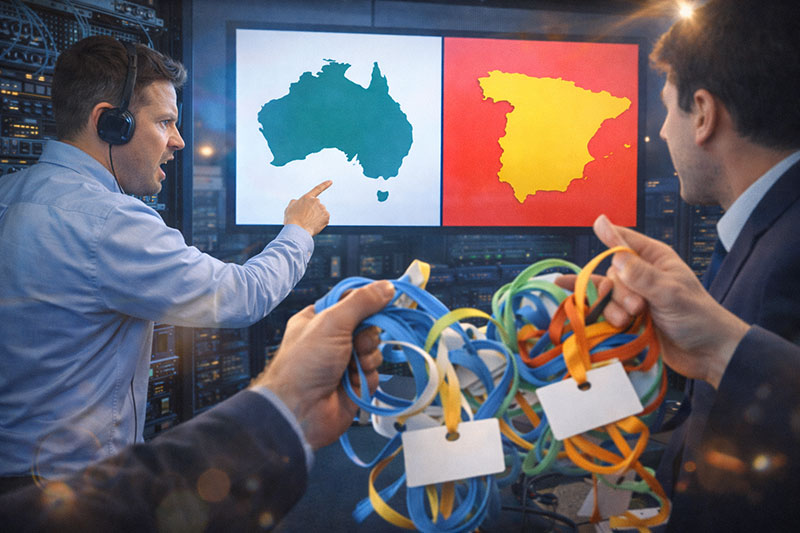
2) Translation ≠ localisation (especially for answer engines)
If you translate your AU page into Spanish without rewriting it for Spain, you usually get:-
unnatural phrasing
-
mismatched examples (Australian references in Spanish content)
-
wrong terminology
-
weak local trust
Localise like you mean it:
-
Spain pages: Spain terminology, Spain examples, Spain references
-
AU pages: Australian terminology, AU examples, AU references
AEO is fundamentally trust-based. “Feels native” is a trust signal.
3) Build local entity signals in both markets
Answer engines don’t just evaluate pages — they evaluate entities (your brand, your expertise, your location signals).Make these obvious:
-
clear business identity and services
-
locale-specific service pages (AU and Spain)
-
local testimonials/case studies where possible
-
author bios with credibility
-
consistent brand mentions across the site (don’t hide behind vague “we” copy)
If you’re remote but serve both markets: say it plainly. Clarity beats clever.
Want this implemented for your site?
If you’re targeting Australia + Spain, AEO gets complicated fast: international SEO setup, localisation, bot access controls, and building pages that are genuinely cite-worthy.
If you want this done properly (and without trial-and-error for months), hire me to implement AEO across your site. I’ll deliver:
-
A crawl + AI bot access audit (ChatGPT / Perplexity considerations)
-
International SEO foundations (hreflang + locale targeting)
-
A set of “citation pages” built to earn AI references (definitions, steps, comparisons)
-
An AU + Spain rollout plan so you know exactly what to fix first
Contact me
for AEO across Australia + Spain.
Content templates that AI answers love (and cite)
Here’s what consistently performs well because it’s easy to extract and hard to misinterpret.
Template 1: Definition + steps + proof
Structure:-
Definition block (50 words)
-
When to use it (3 bullets)
-
How to do it (7 steps)
-
Common mistakes (5 bullets)
-
FAQs (Q → direct answer)
-
Sources (primary references)
This is “answer-engine friendly” by design: short answer blocks + structured guidance + credibility.
Template 2: AU vs Spain split sections
If you serve both markets, use this pattern:-
If you’re targeting Australia: do X (local examples + sources)
-
If you’re targeting Spain: do Y (local examples + sources)
-
If you’re targeting both: do Z (hreflang + localisation workflow)
Answer engines love this because it matches how people ask questions.
Template 3: Comparison blocks (high citation rate)
Use clean tables:-
“ChatGPT vs Google AI features vs Perplexity”
-
“AEO vs SEO”
-
“Subfolders vs subdomains for AU+ES”
Tables are easy to summarise, cite, and validate.
Technical essentials (don’t skip these)
1) Crawl access and bot controls
If you want visibility, you must allow access to the parts of your site you want cited.-
OpenAI documents the relevant crawlers and controls.
-
Perplexity documents how it follows robots.txt and what it may still show even when blocked.
If you’re not sure what’s blocked, check your robots.txt and any WAF rules today — many sites added aggressive AI-bot blocks in 2024–2025 and forgot about them.
2) Structured data (schema)
Schema won’t guarantee citations, but it can help systems interpret content:-
Article schema for editorial pieces
-
FAQ schema where FAQs genuinely help
-
HowTo schema if it’s truly step-based
Use schema honestly. Spam it and you just create noise.
3) Editorial guardrails (avoid “AI slop”)
If your site becomes a factory of generic pages, you’ll lose trust and visibility. Google’s guidance around AI features and content quality is a strong reminder: value, clarity, and reliability win.A simple rule that keeps teams honest:
Every AEO-targeted page must include at least one of: an original framework, real examples, first-hand insight, or primary-source synthesis.
How to measure AEO without making up fake KPIs
AEO measurement isn’t always clean because referral data can be inconsistent. But you can track meaningful signals:
1) Google Search Console (still your baseline)
-
growth in conversational queries
-
impressions/CTR changes
-
index coverage and international targeting issues
2) Brand search lift
When you start appearing in answers, you often see:-
more branded queries
-
more “brand + service” queries
-
more direct traffic
3) AI referrals where visible
OpenAI notes UTM tagging that can help identify ChatGPT referrals in analytics.Treat AI referral data as directional — not a perfect scoreboard.
4) “Citation readiness” audits (quarterly)
-
are your key pages current?
-
are your sources still valid?
-
do AU/ES pages stay properly localised and linked?
FAQ: AEO for Australia + Spain
What is AEO (Answer Engine Optimisation)?
AEO is optimising your content and site signals to be quoted, cited, and linked inside AI-generated answers (ChatGPT, Google’s AI features, Perplexity), not just to rank in traditional results.Is AEO replacing SEO?
No. AEO builds on SEO. Technical foundations and helpful content still matter — AEO adds a focus on quotable structure, trust, and correct localisation.How do I show up in ChatGPT answers?
Publish crawlable, public pages that are easy to cite (definitions, steps, comparisons) and make sure you’re not blocking the relevant OpenAI search crawler.How do I show up in Google AI Overviews / AI Mode?
Follow Google’s site-owner guidance: create content that’s helpful and reliable, with clear structure that answers questions directly and supports deeper exploration via links.Does Perplexity respect robots.txt?
Perplexity states PerplexityBot respects robots.txt for indexing full/partial text, but may still index a domain/headline and a brief factual summary even if blocked.What content formats get cited most often?
Typically:-
short definition blocks
-
step-by-step instructions
- comparison tables
-
Q&A/FAQ sections with direct answers
-
sections backed by primary sources
Do I need schema for AEO?
Schema can help machines interpret your page, but it’s not a cheat code. Use Article/FAQ/HowTo schema only when it genuinely matches your content.How should I structure a site for Australia + Spain (English + Spanish)?
Use distinct URLs for each locale/language version and implement hreflang so systems can serve (and cite) the correct variant.Is translating Australian content into Spanish enough?
Usually not. Translation without localisation often creates mismatched examples and weak trust signals. Spain pages should use Spain-relevant wording, references, and context.How do I measure AEO performance?
Use a mix of:-
Search Console trends (especially conversational queries)
-
brand query lift
-
AI referral signals where visible (e.g.,
utm_source=chatgpt.comfor ChatGPT referrals)
- conversion performance on your “citation pages”
Want to show up in AI answers in Australia + Spain? I can build this for you.
Most businesses won’t lose because they “didn’t use AI.” They’ll lose because their site isn’t set up to be findable, trustworthy, and cite-worthy — especially across two countries and two languages.
If you want AEO implemented end-to-end, hire me. I’ll deliver:
-
AEO + technical audit (ChatGPT / Google AI features / Perplexity readiness)
- AU + Spain international SEO fixes (hreflang + localisation workflow)
-
A citation-first content cluster (pages engineered to be quoted and referenced)
-
A 30–60 day roadmap tied to leads and conversions
Click here to hire me
for AEO across Australia + Spain.Further Reading
- AI SEO vs Traditional SEO: What’s Changed? (and What Still Works?)
- Best Ways to Build E-E-A-T in 2026 (Proof, Original Assets, Authority)
- Technical SEO Checklist (Plain English): Speed, Indexing, Site Health
- Best Demand Gen Content for 2026: What to Publish to Win Leads
-
AEO Explained: How to Rank in AI Answers (ChatGPT, Gemini, Perplexity)