AI SEO vs Traditional SEO: What's Changed? (and What Still Works?)
If you’ve heard “SEO is dead” at least 12 times in the last year, welcome to the club.
What’s actually happened is simpler (and more useful): search has changed shape.
AI answers (like Google’s AI Overviews / AI Mode) now take up more of the SERP, users ask longer and more specific questions, and the web is flooded with look-alike AI content. Google’s own guidance basically boils down to: make genuinely helpful, unique content that satisfies people—especially for more complex queries.
So yes — things changed.
No — the fundamentals didn’t magically stop working.
This post breaks it down with practical, “what do I do now?” guidance.

What is “AI SEO” (in plain English)?
AI SEO is just SEO adapted to AI-shaped search experiences.
That includes:
-
optimising for traditional rankings (blue links still matter),
-
making content easy for systems to understand and extract,
-
and increasing your chances of being included in AI experiences like AI Overviews and AI Mode.
Think of it as: SEO fundamentals + better structure + stronger uniqueness + trust signals.
What changed in the AI era of search
1) The SERP is no longer “10 blue links”
AI Overviews and AI Mode can appear above organic results and change how people click. Google’s site-owner guidance frames these as AI experiences that can include links to “dig deeper” on the web.Practical impact: you’re competing for attention and extraction, not just rank position.
2) People ask longer, messier, more specific questions
Google has explicitly noted that in AI search experiences, users ask longer, more specific questions and follow-up questions.Practical impact: content that only targets short head terms and vague “what is” queries gets commoditised fast.

3) Content supply exploded (and sameness is punished)
It’s easier than ever to publish 1,000 “SEO articles” that all say the same thing. Google’s guidance on using generative AI warns that generating many pages without adding value can violate spam policies around scaled content abuse.Practical impact: “average” content is now worse than useless — it’s a risk.
4) Trust signals matter more because the web got noisier
When a million pages can be generated in a weekend, the differentiator becomes:-
first-hand experience,
-
original insight,
-
clear sourcing,
-
and content that genuinely satisfies the query.
Google’s guidance for succeeding in AI search emphasises unique, non-commodity content that’s helpful and satisfying.
What still works (traditional SEO fundamentals that didn’t die)
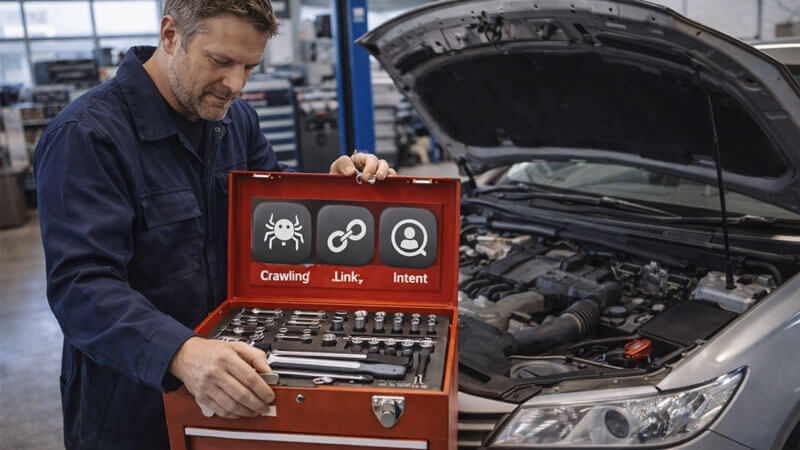
Let’s be blunt: AI didn’t change the laws of physics.
These still drive results:
-
Meeting search intent (answering what people actually want)
-
Crawlability + indexability (tech still matters)
-
Internal linking + topical architecture
-
Authority / reputation signals (mentions, links, credibility)
-
Good UX and clear information architecture
AI SEO is not “a new thing” replacing SEO. It’s SEO with sharper standards.
The big table: What changed vs what still works
| Area | Traditional SEO approach | What changed in the AI era | What to do now |
|---|---|---|---|
| Content strategy | Publish lots of keyword-targeted posts | “Sameness” is everywhere; AI answers absorb basic info | Build fewer, better pages: unique POV, real examples, original data, clear structure |
| Keywords | Focus on short head terms | Queries are longer + multi-step | Optimise for question clusters, tasks, comparisons, “how to choose” flows |
| On-page SEO | Title tags, H1/H2, basics | Extraction matters more | Use scannable structure: direct answers, summaries, definitions, “steps” blocks |
| AI content | “Can AI content rank?” debates | Mass AI pages can trigger spam policies | Use AI to assist; add real value; avoid scaled unoriginal output |
| Technical | Indexing, speed, structured data | Still required; also don’t block key access | Keep fundamentals tight; ensure content is accessible to Google systems |
| Links | Backlinks drive authority | Still important, but “authority + usefulness” wins | Earn links via standout content types (benchmarks, tools, templates, original research) |
| Measurement | Rankings + sessions | Clicks can shift when answers appear | Track conversions, assisted conversions, brand demand, and page-level ROI |
AI content: what’s allowed vs what’s risky
This is where people get it wrong.
AI-assisted content is fine — if you add value
Google’s guidance on generative AI content explicitly says it can be useful for things like research and structuring original content, but warns that using it to generate many pages without adding value may violate spam policies.So the rule isn’t “don’t use AI.”
The rule is:
Don’t publish unoriginal, low-value, scaled output, no matter how it’s created.
What’s risky (and increasingly punished)
-
publishing hundreds of near-duplicate articles targeting slight keyword variations
-
“SEO content” that has no first-hand detail, no examples, no opinion, no original information
-
pages created primarily to manipulate rankings (scaled content abuse)
What’s safe (and wins)
-
AI helping with outlining, structure, summaries, formatting
-
content built from real experience, results, data, customer questions
- pages that include proof, screenshots, templates, calculations, comparisons, or original frameworks
Want an “AI-era SEO” upgrade plan for your site?
If you want, I can audit your site and give you a practical plan:
- what to consolidate or delete (thin/duplicate risk),
- which pages to rebuild for trust + extraction,
- and which buyer-intent clusters to build next for the pipeline.
Just tell me your site + what you sell, and I’ll map the highest-leverage moves first.
Contact me
How to show up in AI features (without chasing ghosts)
Google’s “AI features and your website” guidance is basically: follow SEO best practices and focus on content that’s useful and accessible for inclusion in AI experiences.
Here’s the practical version.
1) Make content “extractable”
AI systems love clean structure:-
clear headings
-
short definitions
-
step-by-step sections
-
direct answers before long explanations
Do this: add “In short:” summaries, bullet lists, and “How it works” blocks.
2) Be uniquely useful (not just correct)
Google recommends focusing on unique, non-commodity content.Ways to do that fast:
-
original examples (real screenshots, real workflows)
-
mini case studies
-
benchmarks / pricing ranges (with caveats)
-
templates people can copy
-
“decision rules” (if X, do Y)
3) Strengthen trust signals
Even if you’re not a giant brand, you can show credibility:-
author bio with relevant experience
-
clear dates and update notes
-
sources for key claims
-
evidence (examples, screenshots, processes)
4) Don’t accidentally block yourself
If your content is hard to crawl/index, you won’t be included anywhere. Google’s AI features documentation is framed from a site-owner perspective and assumes normal inclusion rules still apply.What to measure now (because sessions alone won’t tell the story)
AI answers can change click behaviour. So measurement needs to mature.
Track:
-
Organic conversions (leads, demo requests, sales)
-
Conversion rate by landing page (this becomes everything)
-
Brand demand (growth in navigational searches and direct traffic)
-
Content efficiency (pages that influence pipeline, not pages that “rank”)
If you’re still reporting “we got 12% more traffic,” you’re going to get blindsided.
The 30 / 60 / 90-day plan for modern SEO
Days 1–30: Fix foundations + upgrade key pages
-
tighten technical basics (indexation, internal links, site structure)
-
rewrite or improve your money pages to be:
-
clearer
-
more proof-heavy
-
more structured for extraction
-
clearer
-
kill or merge thin pages (reduce “sameness” risk)
Days 31–60: Build buyer-intent clusters
Create clusters that match decision-making, not just awareness:-
alternatives / comparisons
-
“best X for Y” pages (with genuine criteria)
-
integration pages (if relevant)
-
use-case pages that show outcomes
Days 61–90: Publish “link-worthy” unique assets
This is your moat:-
original research
-
calculators
-
datasets
-
templates
-
frameworks with real examples
This is how you stop competing on commodity content.
FAQ: AI SEO vs Traditional SEO
Is traditional SEO still worth it in 2026?
Yes. Google’s guidance for AI search still emphasises making helpful, satisfying content — classic SEO fundamentals — while users ask longer and more specific questions in AI experiences.Can AI-generated content rank on Google?
AI-assisted content can work, but generating lots of pages without adding value can violate spam policies related to scaled content abuse.What is “scaled content abuse”?
Google defines it as generating many pages primarily to manipulate rankings and not help users, typically involving large amounts of unoriginal content (regardless of how it’s created).
How do I increase my chances of showing up in AI Overviews / AI Mode?
Follow core SEO best practices, keep content accessible, and structure pages clearly so they’re easy to understand and extract for AI features.Do backlinks still matter in the AI era?
Yes — but they’re not a cheat code. Links + reputation still support trust, while unique, satisfying content is what earns inclusion and performance.Conclusion
AI changed the format of search, not the goal of search.
The goal is still: give people the best, most satisfying answer.
If your strategy is “publish more AI posts,” you’ll lose.
If your strategy is “publish fewer, better pages with real value,” you’ll win — even as the SERP evolves.
Want an “AI-era SEO” upgrade plan for your site?
If you want, I can audit your site and give you a practical plan:
-
what to consolidate or delete (thin/duplicate risk),
-
which pages to rebuild for trust + extraction,
-
and which buyer-intent clusters to build next for the pipeline.
Just tell me your site + what you sell, and I’ll map the highest-leverage moves first.
Contact me
Further Reading
- Best SEO + AI Workflow for 2026 (How to Use AI Without Sounding Like AI)
- AEO Explained: How to Rank in AI Answers (ChatGPT, Gemini, Perplexity)
- Best Demand Gen Content for 2026: What to Publish to Win Leads
- Best Ways to Build E-E-A-T in 2026 (Proof, Original Assets, Authority)
- Technical SEO Checklist (Plain English): Speed, Indexing, Site Health
- SEO for SaaS in Australia: What Actually Works in 2026