By Mitch Chadban — SEO & Marketing Strategist, Australia | Updated July 2026
How to Measure AI Search Traffic in GA4
You cannot measure AI search perfectly in one tool. The practical approach is to combine GA4 for identifiable referrals and landing-page performance, Google Search Console for search demand and branded lift, and manual citation testing to confirm whether your pages are actually being referenced inside AI answers. Some signals are measurable, some are inferred, and you need both to judge whether AI search is helping your business.
That distinction matters. A lot of commentary about AI search analytics overpromises what the data can prove. In reality, some AI answer experiences send referrals, some do not, and some influence branded searches or later return visits without leaving a clean attribution trail.
This guide gives you a practical measurement model you can actually maintain. It works best when paired with strong source-quality content such as AEO explained, How to Get Cited in AI-Generated Answers, and How Comparison Content Affects AEO Rankings.
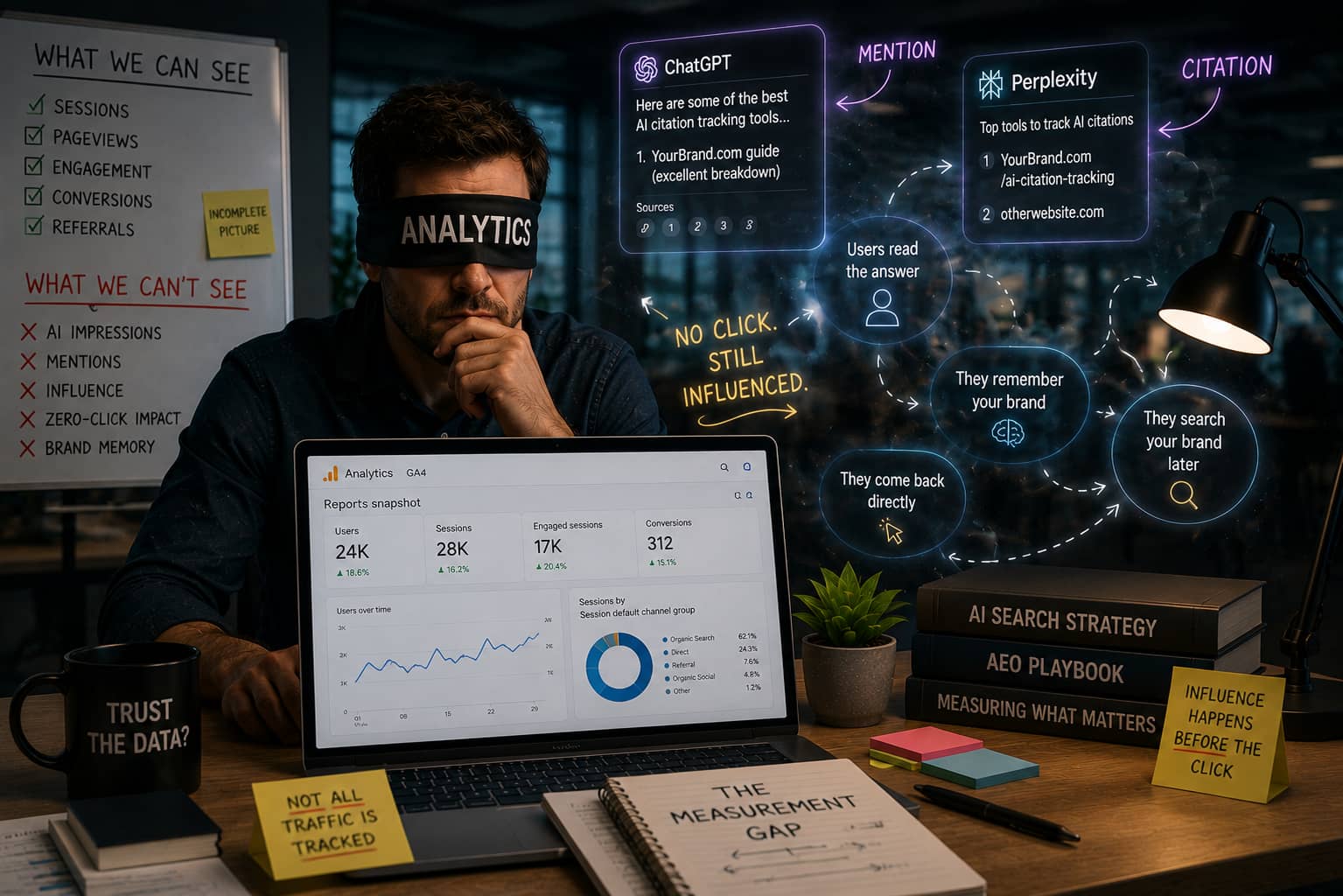
What AI search traffic looks like
AI search traffic does not behave exactly like traditional organic traffic. In some cases, a user sees your site cited in ChatGPT, Perplexity, Gemini or a Google AI search experience and clicks through immediately. In other cases, they read the answer, remember your brand, then come back later through direct traffic, branded search or another channel.
That means AI search performance usually appears through a mix of signals rather than one perfect report. The core signals are:
- identifiable referral sessions from AI platforms,
- stronger performance on pages that tend to get cited,
- growth in branded searches after AI visibility improves,
- manual confirmation that your pages are being cited for important prompts.
If you expect a single dashboard to show every AI answer impression and downstream impact, you will overstate the certainty of the data. The better approach is evidence stacking.
What GA4 can track
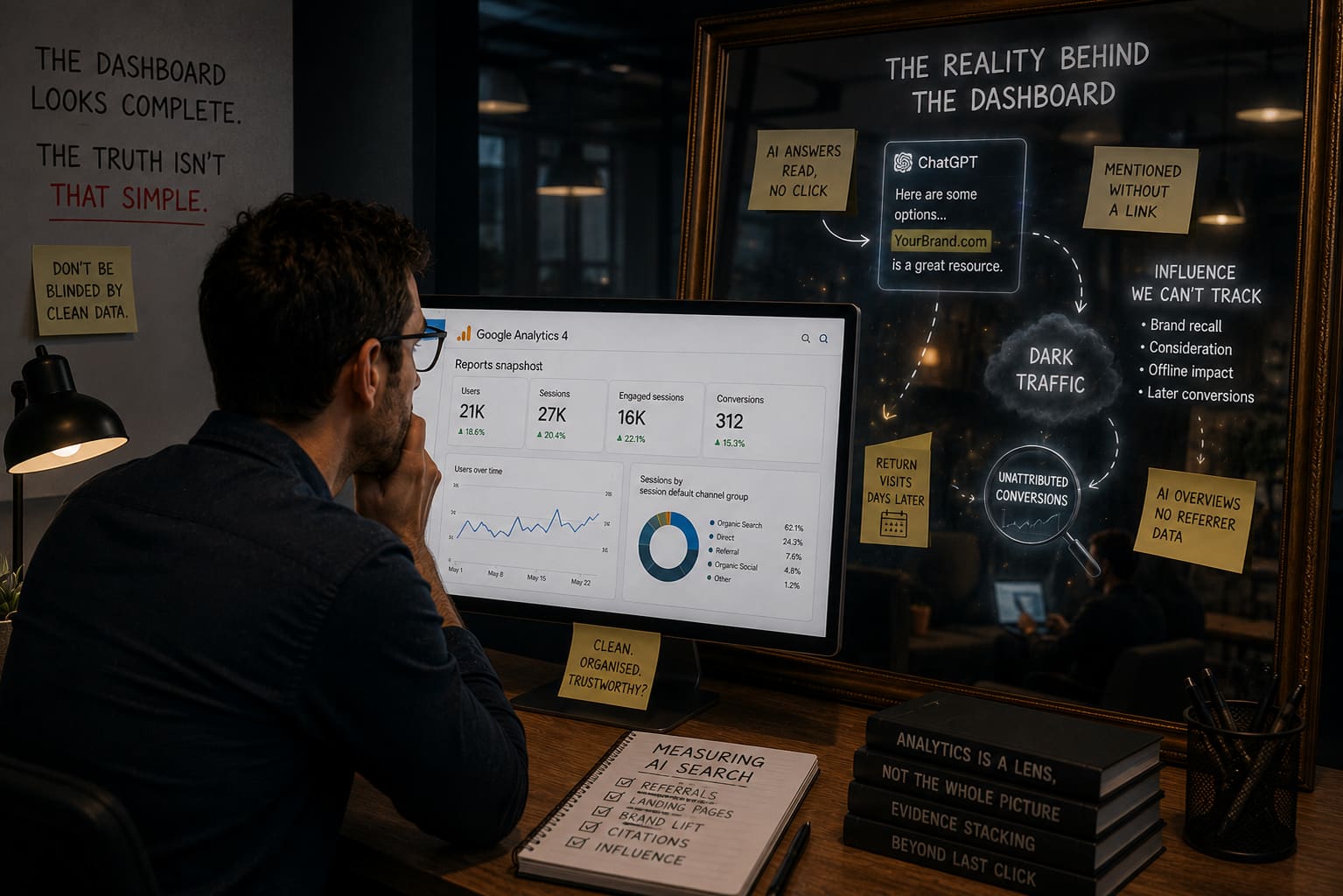
GA4 is useful for measuring what reaches your site with usable session data. It can show whether visits arrived from identifiable AI-related referrals, which landing pages received those visits, and whether those sessions assisted conversions or generated engaged traffic.
GA4 is good for:
- referral traffic from AI platforms when referrers are passed through,
- landing-page performance for cited or citation-worthy content,
- engagement and conversion quality from those visits,
- trend monitoring over time by source and landing page.
GA4 is not good for:
- showing every AI answer impression,
- proving that a later direct session started with an AI answer unless the path is explicit,
- isolating all Google AI search exposure in a clean native report.
So use GA4 for what it does well: measurable visits, landing pages and outcomes. Do not force it to answer a visibility question it cannot fully answer on its own.
What GSC can and cannot show
Google Search Console adds the demand layer. It helps you see whether the pages and topics influenced by AI visibility are also gaining impressions, clicks and query breadth in Google search.
GSC can help you see:
- which landing pages are gaining search visibility,
- whether branded queries are rising over time,
- whether non-branded informational and comparison queries are expanding,
- whether CTR or impressions change as your content cluster improves.
GSC cannot cleanly show:
- all AI Overview or AI Mode exposure as a standalone performance channel,
- whether ChatGPT or Perplexity cited you,
- which exact AI answer caused a later branded search.
That is why GSC should be treated as supporting evidence, not as a complete AI citation report.
Referral sources to monitor
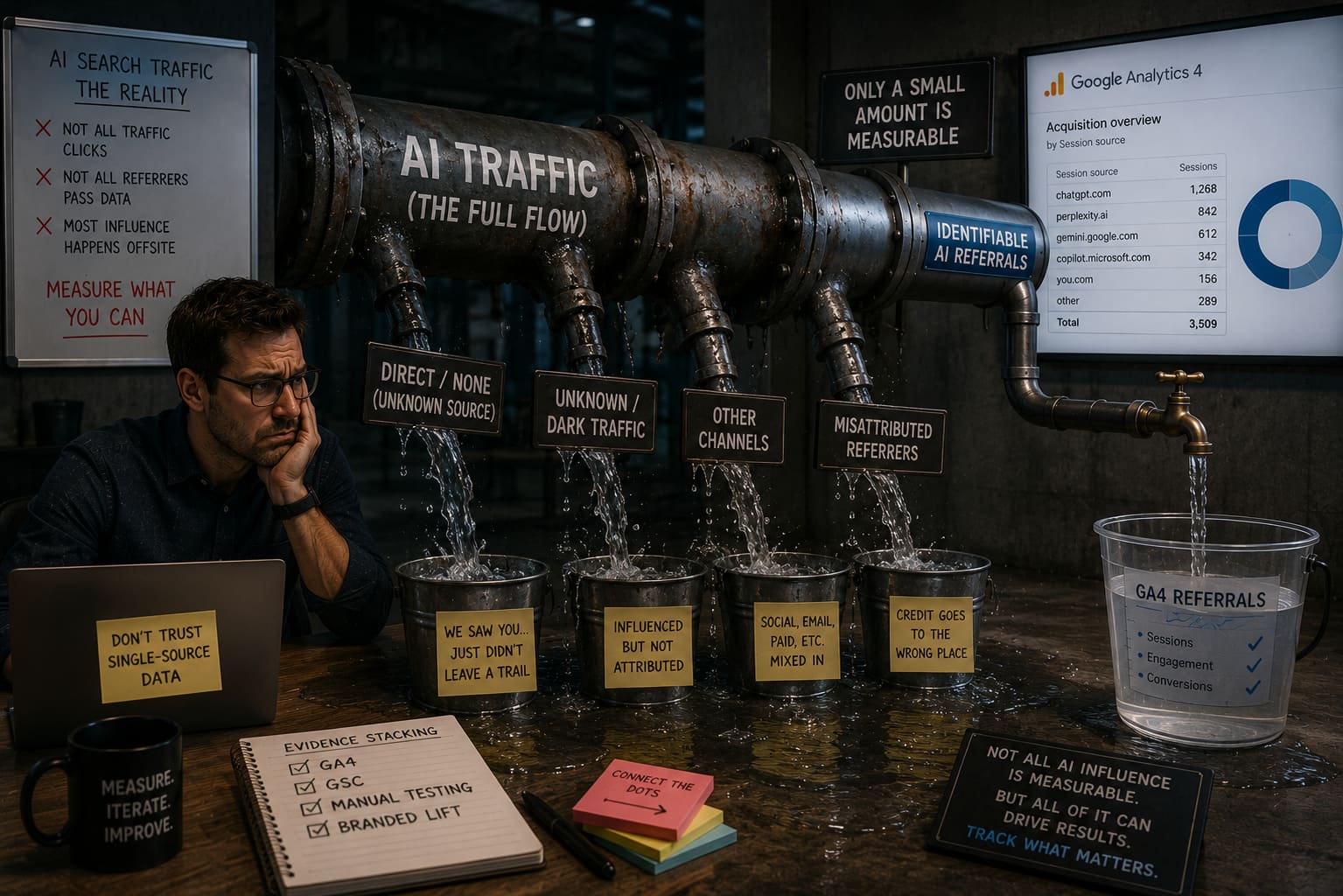
Referral source names change over time, so the goal is not a once-off static list. The goal is to monitor the identifiable AI-related sources that actually appear in your analytics and review that list monthly.
In practice, that often includes sources associated with:
- ChatGPT,
- Perplexity,
- Gemini surfaces when referrals are visible,
- Bing or Copilot-related AI experiences where applicable.
Build a saved GA4 exploration or report filter for those sources. Then review sessions, engaged sessions, key events and conversions by source plus landing page. If you already run an AI-assisted content operation, connect this reporting layer to your production workflow in Best SEO + AI Workflow for 2026.
Landing page analysis
Landing-page analysis is often more useful than source totals. AI-driven discovery tends to favour pages that answer a specific question clearly, compare options, or help a buyer evaluate a decision. That means you should watch the pages most likely to earn citations, not only the traffic source line items.
Review landing pages for:
- sessions from identifiable AI-related sources,
- engagement rate and average engagement time,
- assisted conversions or lead-related events,
- changes in performance after structural content improvements.
Pages with strong direct answers, comparison sections and FAQ blocks often become more measurable because they are more citation-worthy. That is one reason to build the content side properly, not just the reporting side.
Branded search lift
One of the clearest inferred signals is branded search lift. A user may see your brand cited in an AI answer, skip the click, then search for you later by name. GA4 alone will rarely attribute that cleanly, but Search Console can help you see whether branded queries trend upward alongside improved AI visibility.
Look for:
- growth in branded impressions and clicks,
- more brand-plus-service or brand-plus-comparison queries,
- timing overlap between new AI-citation wins and branded search growth.
This is still inference, not certainty. But it is commercially useful inference when combined with referral data and citation checks.
Manual citation tracking
Manual citation tracking is still necessary because many AI answer experiences do not produce full analytics visibility. Each month, test a fixed list of high-value prompts across the AI systems that matter to your audience and record what happens.
Track:
- whether your page is cited, linked or mentioned,
- which page appears,
- which prompt triggered the citation,
- which competitors appear alongside you,
- what answer format was used: summary, list, comparison, FAQ or recommendation.
This makes the measurement honest. It separates “we think AI search is helping” from “we can see our pages being referenced for these prompts.” The content design principles behind that are covered in How to Get Cited in AI-Generated Answers.
AI search measurement table
| Signal | Tool | What it tells you | Limitation | Action |
|---|---|---|---|---|
| AI referral sessions | GA4 | Which identifiable AI-related sources are sending visits | Misses AI exposures that do not pass a referrer or click | Monitor source trends and compare conversion quality by landing page |
| AI landing-page engagement | GA4 | Whether cited or citation-worthy pages attract engaged traffic | Does not prove the page was cited for every visit | Improve weak pages with better answer blocks, tables and stronger CTAs |
| Search visibility growth | GSC | Whether target pages gain impressions, clicks and query breadth | Does not isolate all AI answer exposure | Compare changes before and after content refreshes |
| Branded search lift | GSC | Whether awareness may be increasing after AI visibility improves | Correlational rather than direct attribution | Track branded query trends monthly alongside citation tests |
| Prompt-level citations | Manual testing | Whether your pages are actually being cited for priority prompts | Labour-intensive and subject to answer variability | Use a fixed prompt set and review monthly |
| Assisted conversions from AI-related visits | GA4 | Whether measurable AI traffic contributes to leads or pipeline | Undercounts delayed or unattributed influence | Review assisted paths and lead-quality patterns, not just last-click conversions |
Monthly reporting template
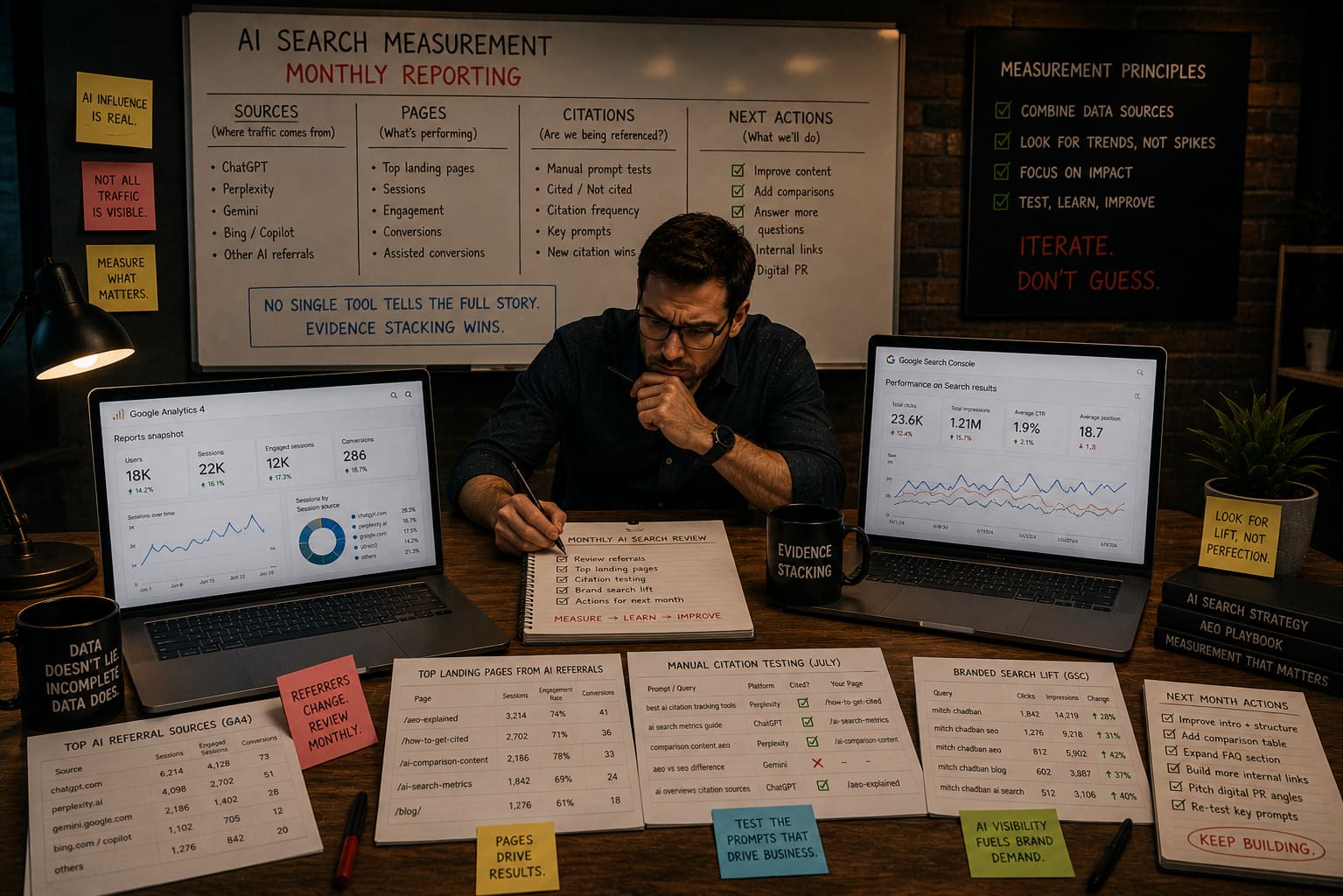
A simple monthly AI search report should answer five questions:
- Which identifiable AI-related referral sources sent traffic this month?
- Which landing pages attracted that traffic, and how well did those sessions perform?
- Did target pages gain search visibility or branded demand in GSC?
- Which priority prompts produced citations, and which pages were cited?
- What should be improved next month: structure, proof, internal links, or CTA alignment?
A practical report usually includes:
- top AI-related referral sources by sessions and conversions,
- top landing pages from those sources,
- branded query trend notes from GSC,
- manual citation wins and losses by prompt,
- next actions for the pages most likely to influence revenue.
Need clean AI search measurement, not guesswork?
If you cannot tell whether AI search is helping or hiding your leads, I can build a simple measurement layer that combines GA4, GSC and citation testing with the content pages most likely to win visibility.
That usually means setting up the right reporting views, prioritising the right landing pages, and fixing the content structure that makes measurement worthwhile in the first place.
FAQ
Can GA4 measure AI search traffic directly?
Partly. GA4 can measure identifiable AI-related referrals and what those visits do on your site, but it cannot capture every AI answer impression or every delayed influence on branded search and direct traffic.
What can Google Search Console show for AI search?
GSC can show page-level search visibility, query growth and branded demand trends. It cannot act as a full AI citation report or cleanly isolate every AI search surface.
What is the best way to measure whether AI answers are helping?
Use a mixed model: GA4 for measurable visits and outcomes, GSC for visibility and branded lift, and manual citation checks for proof that your pages are actually being referenced.
Which pages should I track first?
Start with pages that answer high-intent questions, compare options, or influence commercial decisions. These are usually the pages most likely to earn citations and contribute to revenue.
Why does manual citation testing still matter?
Because AI platforms do not always send a consistent referrer or a click. Manual testing is the practical way to verify whether your content is being used as a source for the prompts that matter most.