By Mitch Chadban — SEO & Marketing Strategist, Australia | Updated July 2026
How to Get Cited in AI-Generated Answers
You cannot guarantee AI citations, but you can increase the likelihood of being cited by making your pages easier to retrieve, easier to extract from, more trustworthy, and more useful for a specific claim or decision. In practice, that means stronger structure, better proof, cleaner technical signals and clearer internal topic support.
AI answer systems such as ChatGPT, Perplexity, Gemini and Google AI search experiences do not cite pages at random. They are more likely to reference pages that look source-worthy for the question in front of them.
If you want the broader foundation first, start with what AEO actually is. If you want the comparison-page angle specifically, see How Comparison Content Affects AEO Rankings.

What an AI citation actually means
An AI citation means the system treated your page as supporting source material for a generated answer. Sometimes that appears as a visible source link. Sometimes it appears as a source card, numbered reference or related page panel. Sometimes the influence is less visible, but the same logic applies: your page was considered useful enough to inform the answer.
That matters because a citation is different from a ranking. A page can rank in search and still fail to get cited. A page can also earn citations for a narrow claim, comparison or explanation even if it is not the dominant page for the broader topic.
The job is not to chase vanity mentions. The job is to make the right pages more citation-worthy for commercially meaningful queries.
Why AI systems cite some pages and ignore others
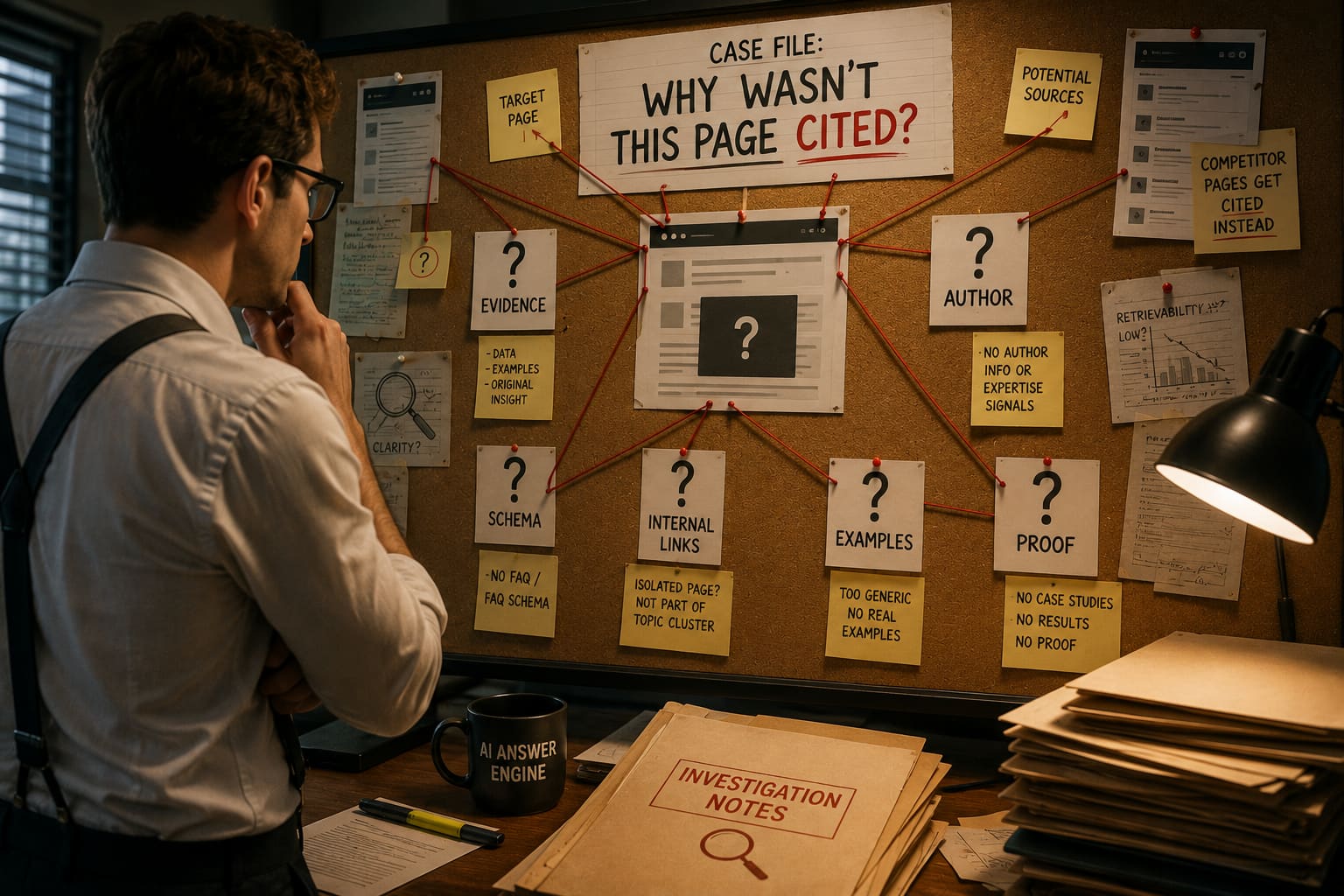
AI systems are more likely to use pages that reduce ambiguity. They prefer source material that is clear, scoped, technically accessible and supported by enough trust signals to feel safe referencing.
- They need an indexable page they can reach and interpret.
- They need a direct answer or explicit takeaway they can extract.
- They need structure that separates key points cleanly.
- They need proof, examples or criteria that make the content specific.
- They need confidence that the page belongs in the topic cluster rather than floating alone.
This is why generic commentary is often ignored. It may be readable, but it does not always help the model answer a real query with confidence.
The citation-readiness checklist

Use this checklist before expecting a page to earn citations consistently.
| Check | Why it matters |
|---|---|
| Indexable page | If the page cannot be reliably discovered, it is unlikely to be selected. |
| Clear canonical | Consolidates signals and reduces ambiguity about the source URL. |
| Direct answer near top | Gives the system a concise summary to extract quickly. |
| Descriptive H2s | Makes sections easier to interpret and quote accurately. |
| Original examples or proof | Adds specificity that generic summaries usually lack. |
| Comparison or decision tables | Helps the system compare options and represent trade-offs clearly. |
| FAQ | Creates clean question-answer pairs that map well to AI queries. |
| Schema | Supports machine-readable context around the page type and content. |
| Author info | Improves trust and context around who is making the claim. |
| Date modified | Helps the page look current, especially for fast-changing topics. |
| Strong internal links | Reinforces topic relevance and cluster support. |
Technical requirements
Technical requirements do not win citations by themselves, but they remove avoidable friction.
- Keep the page indexable and internally discoverable.
- Use a stable canonical that points to the intended URL.
- Make sure the page renders cleanly and does not bury the main content behind confusing layouts.
- Use schema such as
BlogPosting,FAQPageandBreadcrumbListwhere relevant. - Show visible byline and updated date rather than hiding freshness signals.
These are not advanced tricks. They are the minimum conditions that make a source easier for answer systems to trust and interpret.
Google states these eligibility requirements most explicitly, which makes it the clearest platform to work backwards from. The detail sits in how Google AI Overviews choose sources.
Content structure requirements
A citation-worthy page usually makes the answer easy to find before it makes the answer long.
- Lead with a direct answer block in the first section.
- Use H2s that describe the actual questions or decisions being addressed.
- Break complex ideas into named sections, checklists, steps or tables.
- Use comparison and decision formats when the query involves choosing between options.
- Write concise, extractable paragraphs before expanding with detail.
If the page reads like a useful source document, it has a better chance of being cited. If it reads like broad commentary with no explicit structure, the probability drops.
The workflow for producing cleaner, more structured pages is closely related to Best SEO + AI Workflow for 2026.
Proof and trust requirements

AI systems are more likely to reference material that feels specific and defensible. That is where proof matters.
- Use examples tied to real scenarios rather than abstract advice.
- State the criteria behind comparisons or recommendations.
- Include original framing, observations or evidence where possible.
- Make sure author context and expertise are visible enough to reduce ambiguity.
- Avoid overclaiming or presenting guesses as certainty.
You are not trying to sound impressive. You are trying to make the page look reference-worthy.
Internal linking and entity clarity
Internal linking helps AI systems understand that a page belongs to a broader topic cluster rather than existing as an isolated post.
At minimum, a citation-focused page should connect to:
- the foundational pillar for the topic,
- support pages that handle comparisons, measurement or sub-questions,
- and the relevant commercial or contact path.
That is why this page should sit alongside the AEO explainer, How Comparison Content Affects AEO Rankings, and How to Measure AI Search Traffic in GA4 rather than standing alone.
Monthly citation testing workflow
Citation-readiness is only half the job. You still need a repeatable testing workflow.
- Choose 15 to 20 priority prompts tied to your real services, comparisons and buyer questions.
- Test them monthly across ChatGPT, Perplexity, Gemini and relevant Google AI search experiences.
- Record whether your brand or page was cited, and which page was selected.
- Note which competitors appeared instead and what their content did better.
- Refresh the pages that are close but not consistently selected.
That testing layer matters because AI search visibility is partly measurable and partly inferred. For the analytics side, use How to Measure AI Search Traffic in GA4 alongside your manual prompt checks.
Want to know if your pages are citation-ready?
If you want to know whether your pages are likely to be used as sources, I can audit them for AI retrieval, structure, proof and technical gaps, then show what to fix first.
The practical goal is not to chase guaranteed citations. It is to make your most important pages more citation-worthy, more useful and more commercially effective. Start with a citation-readiness review.
FAQ: How to get cited in AI-generated answers
What does an AI citation actually mean?
It means the answer system chose your page as source material for a specific answer, comparison, checklist or claim. It signals source selection, not guaranteed traffic.
Can you guarantee AI citations?
No. The realistic goal is to increase the likelihood of being cited by improving structure, proof, technical clarity and cluster support.
What pages are most likely to get cited?
Pages with direct definitions, comparison tables, clear criteria, FAQs, useful frameworks and concrete examples are generally easier to cite than vague narrative pieces.
Do technical fixes matter for AI citations?
Yes, but as enablers rather than magic. Indexability, canonicals, schema, author information, updated dates and strong internal linking make a good page easier to trust and interpret.
How often should I test AI citation visibility?
Monthly is a practical cadence for most businesses. It gives you a stable enough view to notice movement without obsessing over day-to-day fluctuations.